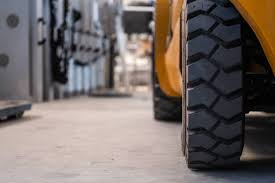
Tyre selection is one of those decisions that most operations get wrong at least once. Not badly wrong — the machine still runs — but wrong enough that the tyres wear faster than they should, or operators are grinding through shifts on a surface the tyre was never designed for, or you’re replacing a set every eight months when you should be getting two years out of them.
The problem usually starts at the point of purchase. Most tyre suppliers carry one or two tyre types and steer every customer towards what they have in stock. That works out fine when the stock happens to match the application. When it doesn’t, you end up with a compromise that costs more over time than the initial saving was worth.
At GP Forklifts, the range covers all four main categories: solid, pneumatic, foam-filled, and polyurethane. The GP Solid branded line adds a further layer of choice across the most widely used sizes in South Africa. What follows is a breakdown of each type — what it is, where it performs well, and where it doesn’t.
Why the Tyre Type Matters More Than You Think
Here is the simplest way to frame it: the tyre is the only point of contact between a loaded machine and the ground. Steering response, load stability, vibration, traction — all of it runs through that contact patch. Get the type wrong and you are working against the application from the start.
A solid tyre on a rough outdoor yard will wear unevenly and transmit enough vibration to affect operator performance by the end of a shift. A pneumatic tyre in a warehouse with floor debris is a puncture waiting to happen. Neither of these is a disaster in isolation, but across a fleet operating twelve hours a day, those costs accumulate in ways that are entirely avoidable.
The tyre conversation is worth having before a machine goes into service. Not after the first set has worn out prematurely.
Solid Forklift Tyres
Solid tyres are the default for most South African warehouse and distribution operations, and it’s not hard to see why. There’s no air cavity — the tyre is exactly what the name says. That means no punctures, no blow-outs, no pressure checks, and no tyre-related downtime beyond the eventual end-of-life replacement.
They press onto a bead-seat rim, which gives a stable, permanent fitment that holds under lateral load. The lower profile also keeps the machine’s centre of gravity slightly lower than a pneumatic equivalent, which is a real stability benefit when operating at full rated capacity.
The surface requirement is worth being specific about. Smooth, hard floors are what solid tyres are built for. Warehouses, cold stores, food processing plants, sealed concrete factories — these are the environments where they work properly. Take them onto rough or uneven ground and two things happen fast: traction becomes unpredictable and the ride gets uncomfortable enough to matter over a full shift. Without an air cushion, every surface imperfection is transmitted directly to the machine and the operator. On the right floor, though, there’s very little argument against them.
The GP Solid Tyre Range
The GP Solid range is GP Forklifts’ own branded solid tyre line, covering the sizes that account for the bulk of counterbalanced and reach truck fitments in South Africa. Available sizes include the 300×15, 500×8, 600×9, 650×10, 700×12, 815×15, and 825×15. Each page includes load ratings and fitment specifics.
These sizes cover the fitment requirements for Toyota, Nissan, Mitsubishi, Hyster, Yale, Linde, Crown, and Clark machines. If you’re working off a brand not on that list, the team can help confirm the correct size from your tyre sidewall marking or the machine’s specification plate.
Pneumatic Forklift Tyres
Pneumatic tyres are air-filled, and that air column is doing real work. It absorbs impact, allows the tyre to deform over uneven ground, and gives the machine traction on surfaces where a solid tyre would struggle. Open yards, gravel, compacted earth, timber storage areas, port facilities, building sites — these are pneumatic territory.
The ride quality difference is noticeable to any operator who’s moved between machine types. On rough surfaces over a long shift, the air cushion reduces fatigue in a way that’s hard to put a number on but easy to feel. It also helps with directional stability on uneven terrain, because the tyre maintains ground contact more consistently as the surface changes beneath it.
The limitations are equally real. Sharp objects — nails, metal offcuts, stone fragments — are a genuine risk, and a blow-out on a loaded forklift is a safety event. Pneumatics also require regular pressure checks; running under-inflated accelerates shoulder wear and affects load stability in ways that aren’t always immediately visible but show up clearly on the replacement schedule.
For environments where the ground can be kept reasonably clear and pressure maintenance is part of the routine, pneumatics are the correct choice on anything other than a smooth indoor floor.
Foam-Filled Forklift Tyres
Foam-filling takes a standard pneumatic tyre and replaces the air with a polyurethane foam compound. Once cured, the cavity is permanently filled. There’s no pressure to lose, no puncture risk, nothing to check. The tyre is effectively puncture-proof.
What’s worth understanding here is that the tyre still behaves more like a pneumatic than like a solid. The foam allows some deformation under load, which means it retains more ride quality and ground compliance than a solid tyre offers. It won’t absorb impact as effectively as a properly inflated pneumatic, but on rough outdoor surfaces it’s noticeably more forgiving than going solid.
This combination is particularly useful in high-risk environments where pneumatic punctures would otherwise be a near-daily occurrence. Scrap metal yards, steel plants, recycling facilities, construction and demolition sites — places where the ground is genuinely punishing. Foam-filling handles the same terrain without the associated downtime.
One practical consideration: foam-filled tyres are considerably heavier than the pneumatic shells they’re based on. That additional weight affects the machine’s counterbalance calculation. Before switching an existing machine from pneumatic to foam-filled, it’s worth getting a qualified forklift technician to check the axle load implications. It’s usually fine — but it’s a check worth making.
Polyurethane Forklift Tyres
Polyurethane tyres are a specialist product for a specific set of machines and environments. You’ll find them on electric pallet jacks, order pickers, and narrow-aisle reach trucks — equipment that operates entirely on smooth, sealed floors and where marking or contaminating that floor isn’t acceptable.
The compound doesn’t scuff sealed epoxy or resin surfaces the way rubber does. In pharmaceutical warehouses, food facilities, and clean rooms, floor marking protocols can be strict enough that this distinction becomes a hard requirement rather than a preference. Polyurethane meets it; rubber generally doesn’t.
Rolling resistance is the other genuine advantage. Lower rolling resistance extends battery run-time on electric machines — and on a facility running multiple shifts on battery power, that efficiency difference adds up across a fleet over the course of a year. The tyres also handle oil and chemical contamination better than rubber equivalents, which matters in certain production environments.
The operating envelope is narrow. Polyurethane tyres are built for smooth, level, indoor floors. On anything uneven, the hard compound transmits impact directly, wears unevenly, and the operator experience drops off quickly. They solve a specific problem well. Outside of that specific problem, they’re the wrong answer.
Matching the Tyre to the Application
Start with the environment, not the machine. A forklift that works exclusively on a smooth warehouse floor has a simple brief. A machine splitting its day between an indoor loading bay and an outdoor yard is a harder call, and in that situation it’s worth thinking about which environment puts more stress on the tyre and weighting the choice accordingly.
For predominantly indoor work on sealed or smooth concrete, solid tyres cover most requirements without complications. No maintenance overhead, no puncture exposure, consistent performance on the surface they were designed for. The GP Solid range handles the counterbalanced machine side of this well across the most common South African fleet sizes.
For outdoor work or mixed indoor/outdoor use with manageable floor conditions, pneumatics give you the traction and ride quality the application needs. Where the outdoor surface is rough and debris-heavy, foam-filling removes the puncture risk while keeping more ground compliance than solid tyres would give you.
For electric narrow-aisle equipment on smooth sealed floors — particularly in sensitive environments — polyurethane is the correct specification. Anywhere else, it isn’t.
Load ratings run through all of this. Every tyre type carries a rated capacity, and that rating needs to meet or exceed the machine’s rated lift capacity. An under-rated tyre on a machine operating regularly at full load doesn’t save money. It shortens the tyre’s life and creates a safety margin issue that isn’t worth the cost difference.
Why Operators Come Back to GP Forklifts
Availability is the practical answer most operators give. When you need a specific tyre size in a specific category, a supplier stocking across the full range gives you the right tyre. A supplier with limited stock gives you a compromise. Over time, those compromises show up in wear patterns, replacement frequency, and operator feedback that traces back to a tyre that was never quite right for the application. GP Forklifts keeps commonly requested solid tyre sizes in stock and works to turn around fitments and dispatch orders quickly.
For fleet operators managing machines from multiple brands — which is the reality for most medium to large South African distribution and manufacturing operations — sourcing Toyota, Hyster, Yale, Nissan, Mitsubishi, and Linde fitments from a single account simplifies procurement in a way that has genuine administrative value. Fewer supplier accounts, fewer invoices, fewer conversations to chase.
The other factor is support at the point of purchase. If you’re uncertain which size your machine takes, or you’re evaluating a switch from one tyre type to another, that’s a conversation worth having before placing an order.
Frequently Asked Questions
What is the difference between a solid tyre and a cushion tyre?
They’re the same product. ‘Cushion tyre’ is the term used in North American markets; ‘solid tyre’ is the standard South African and British term. Both describe a tyre with no air-filled cavity — solid rubber throughout, fitted to a bead-seat rim. If a supplier uses either term, they’re referring to the same thing.
Can I fit pneumatic tyres to a machine that came with solid tyres?
Not without a rim change. Solid and pneumatic tyres use different rim configurations, and the swap affects the overall wheel diameter, ground clearance, and potentially the machine’s load ratings and stability. It’s possible, but it needs to be assessed by a qualified forklift technician first. Don’t treat it as a straightforward substitution.
How do I read a forklift tyre size from the sidewall?
Forklift tyre sizes are expressed as width x rim diameter in inches. A tyre marked 7.00-12 is 7 inches wide and designed for a 12-inch rim. Solid tyres sometimes use a slightly different format — 700×12, for instance — which refers to the same physical dimensions. If you’re unsure, check the machine’s specification plate, or contact the GP Forklifts team to help match the size.
How long should a forklift tyre last?
It varies considerably. A solid tyre on a well-maintained warehouse floor under moderate daily use can last three to five years. A pneumatic tyre on a rough outdoor yard in heavy-use conditions might need replacing within twelve to eighteen months. Operating surface, daily load cycles, and operator habits all affect wear rate significantly. The wear indicator moulded into the tyre tells you when you’ve reached the end of serviceable life. Don’t run past it.
Does GP Forklifts supply tyres for all forklift brands?
Forklift tyres are specified by size and rim type, not by machine brand. As long as the tyre size and rim configuration match your machine’s requirements, the tyre fits — regardless of who made the forklift. The GP Solid range and the other types stocked at GP Forklifts cover the sizes used across Toyota, Hyster, Yale, Nissan, Mitsubishi, Linde, Clark, Crown, and other brands common in South Africa.
For the full range of GP Solid tyre sizes and all other forklift tyre options, visit gpforklifts.co.za or speak directly with the team to confirm the right specification for your machine and working conditions.