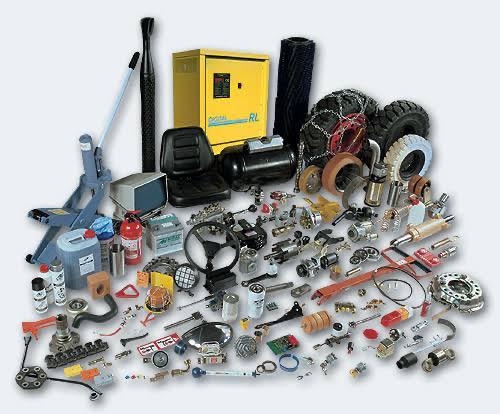
A forklift might look like one solid machine, but it’s made up of dozens of individual components — each one doing a very specific job. When any one of those parts fails or wears down, your entire operation can grind to a halt. This guide breaks down every major forklift part in plain language: what it does, why it matters, what to watch for when it starts failing, and where you can source a replacement in South Africa.
Whether you’re managing a warehouse fleet, running a single machine on a construction site, or just trying to make sense of a mechanic’s quote — this is the reference you’ve been looking for.
What Are the Main Parts of a Forklift?
A forklift is made up of several core systems that work together — the lifting assembly, the powerplant, the transmission and drive system, the hydraulics, the steering, the brakes, and the tyres.
Most people know what a forklift looks like, but understanding the individual systems makes it far easier to catch problems early and make informed decisions about repairs and replacements. Here’s a high-level breakdown before we get into the detail of each component:
- Lifting assembly: mast, forks, carriage, lift chains, tilt cylinders
- Powerplant: engine (LPG, diesel, or electric motor and battery)
- Transmission: torque converter, gearbox, drive axle
- Hydraulic system: pump, control valves, cylinders, hoses, fluid reservoir
- Steering system: steering axle, power steering unit, linkages
- Brakes: service brakes, parking brake, brake pads and discs
- Electrical system: alternator, starter motor, wiring, sensors, instrument cluster
- Tyres: solid, pneumatic, or polyurethane
- Cab and safety components: overhead guard, seat, seatbelt, horn, lights
- Filters and fluids: oil filter, fuel filter, hydraulic filter, air filter
We’ll cover each of these in detail below.
What Does the Forklift Mast Do and When Should It Be Replaced?
The mast is the vertical assembly at the front of the forklift that raises and lowers the load — it’s essentially the backbone of the lifting system.
It consists of two or more interlocking steel channels that slide against each other as the carriage moves up and down. Most forklifts come with either a two-stage (duplex) or three-stage (triplex) mast, with triplex being common where low clearance and high lift heights are both required.
Masts don’t fail outright very often, but they do wear over time. The rails and rollers develop play, the channels can crack under overloading, and the weld points around the tilt bracket are susceptible to fatigue. If you’re seeing visible bending, cracking, or excessive rocking during lifts, get it inspected immediately — mast failure under load is a serious safety incident waiting to happen.
Mast rollers, bushings, and the lift chains that travel through the mast are parts that need routine attention. Chains in particular should be inspected regularly for elongation, corrosion, and broken links. The standard rule of thumb is that a chain elongated beyond 3% of its original pitch should be replaced.
GP Forklifts stocks mast components, lift chains, rollers and related parts for most major brands. You can browse available parts or get in touch through the forklift parts page.
What Are Forklift Forks and Why Do They Wear Out?
Forklift forks — also called tines — are the two steel blades that slide under a load to lift and transport it, and they’re one of the most visibly worn parts on any working forklift.
They look simple, but forks carry enormous stress with every lift cycle. Constant impact with pallet edges, floors, racking legs, and uneven surfaces causes surface wear, blade bending, and heel cracking over time. OSHA and South African safety regulations require forks to be taken out of service when wear at the shank or blade exceeds 10% of their original thickness.
It’s also worth noting that forks should always be replaced in pairs — using one new and one worn fork creates an uneven load distribution that can tip a pallet mid-air. That’s not a risk worth taking.
Forks come in standard widths and lengths (ISO 2328), but specialised variants exist for carpet handling, paper rolls, side-shift attachments, and more. If you’re running non-standard loads, the fork spec matters as much as the rest of the machine.
GP Forklifts can assist with fork sourcing for your specific machine and load requirements — visit the forklift spares page to get started.
What Is a Forklift Carriage Assembly?
The carriage is the horizontal platform that the forks attach to, and it slides up and down within the mast — it’s the connection point between the lifting mechanism and the load-carrying forks.
The carriage rides on rollers that run along the mast channels. It also provides the interface for side-shift attachments, fork positioners, and other hydraulic add-ons. The rollers, bearings, and side-shift cylinders on the carriage are wear parts that need regular attention.
When carriage rollers wear down or seize, you’ll notice uneven mast movement, excessive side play, or grinding sounds during lifting. Left unattended, worn rollers accelerate damage to the mast channels — turning a cheap repair into a major rebuild.
What Does the Overhead Guard on a Forklift Do?
The overhead guard — sometimes called a ROPS (Roll-Over Protection Structure) — is the steel frame above the operator’s cab that protects the driver from falling objects and rollover incidents.
It’s a safety-critical component and isn’t optional in any professional or regulated environment. Guards can sustain damage from low roof clearances, racking impacts, and loading bay collisions. Any cracking, bending, or broken welds in the overhead guard structure must be addressed before the machine returns to service — a compromised guard offers very little real protection.
Replacement guards are available for most forklift models. If yours has taken a knock and you’re not sure whether it’s still structurally sound, get it assessed rather than guessing.
What Is a Forklift Counterweight and Why Does It Matter?
The counterweight is the heavy cast iron block bolted to the rear of a counterbalance forklift — without it, the machine would tip forward the moment it lifted a loaded pallet.
Counterweights are rated to balance the forklift’s maximum load capacity. They’re generally not a part that gets replaced often, but damage can occur from rollover incidents or severe collision. More commonly, owners add aftermarket weights when trying to lift heavier loads than the machine was rated for — which is extremely dangerous and invalidates the manufacturer’s capacity rating entirely.
If your counterweight has been damaged or you’re dealing with instability that wasn’t there before, contact a forklift specialist before putting the machine back into operation.
How Does a Forklift Engine Work and What Parts Does It Need?
A forklift engine works much like a vehicle engine — converting fuel (diesel, LPG, or petrol) into mechanical energy to power the drive system and hydraulic pump — but it operates under sustained, heavy loads that most vehicle engines rarely experience.
The engine is connected to both the transmission (which drives the wheels) and the hydraulic pump (which powers the lift and steering systems). It’s under load almost continuously during a working shift, which is why engine wear happens faster on forklifts than on most road vehicles.
Key engine parts that need regular attention:
- Spark plugs (LPG/petrol) or glow plugs (diesel) — worn plugs cause hard starting and poor power
- Fuel injectors — dirty or worn injectors lead to rough running and black smoke
- Timing belt or chain — a snapped belt is catastrophic; replace on schedule
- Thermostat and cooling system — overheating is one of the most common causes of engine damage on forklifts
- Engine mounts — worn mounts cause excessive vibration that damages surrounding components
- Carburettor or LPG regulator — controls fuel mixture; worn regulators affect power and emissions
Electric forklifts don’t have a combustion engine, but they have their own critical powertrain components — drive motors, contactors, and the battery management system. We’ll cover those under the electrical section below.
GP Forklifts carries engine components across all major forklift brands. Contact their team through the contact page for availability and pricing.
What Is a Forklift Hydraulic System Made Up Of?
The hydraulic system is what actually lifts the load — it uses pressurised fluid to extend and retract the cylinders that move the mast, tilt the carriage, and operate any attachments.
It’s one of the most maintenance-intensive systems on the forklift, and also one of the most commonly neglected. A hydraulic problem doesn’t just affect lift performance — it affects safety, because a failing system can cause loads to drift or drop unexpectedly.
Main hydraulic components:
- Hydraulic pump — driven by the engine, creates the system pressure; a worn pump produces weak, slow lifting and is often the first hydraulic part to go
- Control valve (directional control valve) — operated by the levers in the cab; routes fluid to the correct cylinder; internal wear causes spongy or drifting controls
- Lift cylinders — the main cylinder runs through the mast and extends as the load rises; seals wear and cause oil weeping or slow lowering
- Tilt cylinders — control the forward and back tilt of the mast; seal failure causes the mast to creep forward under load
- Hydraulic hoses and fittings — high-pressure hoses degrade with age, UV exposure, and heat; cracked or bulging hoses should be replaced before they burst
- Hydraulic oil reservoir and filter — clean fluid is essential; contaminated oil destroys pump and valve internals quickly
Hydraulic fluid itself should be changed at the manufacturer’s recommended intervals — typically every 1,000 to 2,000 operating hours. Running old, contaminated fluid through a forklift’s hydraulic system is one of the fastest ways to write off an expensive pump.
GP Forklifts supplies hydraulic parts including cylinders, seals, hoses, and control valves. Their forklift maintenance service also covers full hydraulic system inspections.
What Are Forklift Tyres and Which Type Do You Need?
Forklift tyres are not the same as vehicle tyres — they’re purpose-built for the extreme lateral and point loads that forklifts generate, and choosing the wrong type will cost you in both performance and safety.
There are three main types:
- Solid (cushion) tyres — pressed onto the rim with no air inside; puncture-proof, lower rolling resistance on smooth warehouse floors; the standard choice for most indoor applications
- Pneumatic tyres — air-filled like a car tyre; better shock absorption on rough or uneven surfaces; suited to outdoor use, yards, and loading docks
- Polyurethane tyres — used primarily on electric reach trucks and narrow-aisle forklifts; extremely long life and low rolling resistance on very smooth floors
Tyre wear on forklifts isn’t always obvious because the wear pattern is different to road vehicles. Chunking, flat spots, and sidewall cracking are the main indicators to watch. Solid tyres should be replaced when the wear line (typically a groove or colour band) becomes visible.
GP Forklifts supplies GP Solid forklift tyres across South Africa, including a range of sizes from 500×8 through to 28×9-15 and beyond. View the full tyre range at the forklift tyres page, or find solid tyres available
What Is a Forklift Transmission and How Does It Fail?
The transmission transfers power from the engine to the drive wheels — it’s what allows the forklift to move forwards and backwards, and to vary its speed and torque.
Most counterbalance forklifts use a hydrostatic or torque converter transmission rather than a conventional manual gearbox. These are generally robust, but they do develop faults over time.
Transmission parts to watch:
- Torque converter — connects the engine to the transmission via fluid coupling; a failing torque converter causes sluggish performance and overheating
- Forward/reverse clutch packs — wear causes slipping, delayed engagement, or burning smell
- Drive axle and differential — houses the final drive gears; worn bearings cause noise and vibration; leaking seals allow lubricant loss which accelerates wear
- Inching valve — used on torque converter machines to allow simultaneous high engine revs and slow travel speed; a critical part for precise load positioning
Transmission problems often start subtly — a slight delay in drive engagement, a faint burning smell, or reduced pulling power on ramps. Catching these early is far cheaper than a full transmission rebuild.
What Do Forklift Brakes Consist Of?
Forklift brakes consist of the service brakes (used during normal operation to slow and stop the machine), the parking brake (holds the machine stationary when parked), and sometimes an inching/brake pedal combination unique to counterbalance forklifts.
Drum brakes are the most common setup on counterbalance forklifts — the brake shoes expand against a drum inside the wheel hub. Disc brakes appear on some newer models and are generally lower maintenance.
Common brake wear parts:
- Brake shoes and linings — wear progressively; excessive pedal travel or grinding indicates replacement is overdue
- Wheel cylinders — hydraulic cylinders that actuate the shoes; leaking cylinders cause uneven braking or complete brake fade
- Brake drums — grooves and scoring develop with age; drums can be machined to a point before replacement is required
- Parking brake cable and mechanism — cables stretch and fray; the mechanism needs periodic adjustment to maintain holding force
Forklift brakes are safety-critical. Never delay brake repairs — an unloaded forklift can weigh four to eight tonnes, and that’s a lot of momentum on a warehouse floor.
GP Forklifts’ team of expert mechanics handles brake inspections and repairs as part of their forklift repair services.
What Are the Electrical Components in a Forklift?
The electrical system powers everything from the starter motor and alternator through to the instrument cluster, safety sensors, and — in electric forklifts — the traction motor and battery management system.
On LPG and diesel forklifts:
- Starter motor — engages the engine at start-up; a slow or non-cranking engine is often a starter motor fault
- Alternator — charges the battery and powers electrical systems while running; a failing alternator causes battery drain and eventual no-start
- Battery — typically 12V for engine starting; corroded terminals and low electrolyte levels are the most common causes of electrical gremlins
- Wiring harness — heat, vibration, and rodents damage wiring over time; intermittent faults are often wiring-related
- Sensors — temperature, oil pressure, and speed sensors; failure causes warning lights and can trigger safety shutdowns
- Instrument cluster and warning systems — hourmeter, fuel gauge, temperature gauge; keeping these functional ensures problems are caught early
On electric forklifts:
- Traction motor and drive controller — the heart of the electric drivetrain; controller faults often present as error codes
- Pump motor — drives the hydraulic pump; separate from the traction motor on most designs
- Battery — typically 24V to 80V depending on machine size; battery capacity degrades over charge cycles and cell failures reduce runtime significantly
- Contactors and relays — high-current switching components; worn contactors cause arcing and intermittent power
- Charger — onboard or external; a faulty charger is one of the most overlooked causes of battery deterioration
For electrical diagnostics and component sourcing, GP Forklifts offers specialist support through their expert forklift mechanics.
What Is a Forklift Steering System?
The forklift steering system controls direction by steering the rear wheels — unlike a car, which steers from the front — and this rear-wheel steering design gives forklifts their tight turning radius in confined spaces.
Most forklifts use power-assisted steering driven by the hydraulic system. The key components include the steering axle (rear), the steering cylinder, the orbital motor (or power steering unit), and the steering linkages.
Steering faults include excessive play in the steering wheel, the machine pulling to one side, or heavy steering that requires significant effort. The orbital motor is often the culprit in power steering failures — wear causes reduced assist and eventually full manual steering load.
Worn steering components also affect tyre wear significantly. A forklift with misaligned or worn steering geometry will chew through rear tyres at an accelerated rate.
What Filters Does a Forklift Need and How Often Should They Be Changed?
Forklift filters protect the engine, hydraulic system, and fuel system from contamination — and they’re one of the cheapest things you can replace, compared to what happens when you don’t.
The four essential forklift filters:
- Engine oil filter — changed with every oil service, typically every 250 to 500 operating hours; running without a functioning filter allows metal particles to circulate through the engine
- Air filter — cleans intake air before it enters the engine; critical on dusty sites; a blocked air filter causes power loss and excessive fuel consumption
- Fuel filter — keeps debris and water out of the fuel system; dirty filters cause rough running, hard starting, and injector damage
- Hydraulic filter — protects the hydraulic pump and control valves from contaminated fluid; should be changed every 500 to 1,000 hours depending on the manufacturer
Filter servicing isn’t glamorous, but it’s the single most cost-effective maintenance task you can do. Skipping filter changes to save money is a false economy that typically ends with a bill for something far more expensive.
GP Forklifts stocks filters for all major brands and can assist with full service schedules. Their forklift maintenance services cover preventative maintenance programmes across South Africa.
Which Forklift Brands Does GP Forklifts Supply Parts For?
GP Forklifts supplies genuine and aftermarket forklift parts for most of the major brands operating in South Africa — covering both the common warehouse machines and the heavier-duty industrial units.
Supported brands include:
- Toyota — the most widely used brand in South Africa; GP Forklifts stocks a comprehensive range of Toyota forklift parts
- Yale — popular in distribution and manufacturing; parts available across the model range
- Hyster — heavy-duty counterbalance forklifts; parts available for older and newer models
- Nissan — reliable and widely serviced; comprehensive parts availability
- Mitsubishi — common in light to medium industrial applications; parts stocked and sourced
- Clark — well-established brand with a strong parts inventory at GP Forklifts
- TCM — Toyota-manufactured brand; parts available through GP Forklifts
- Doosan — Korean-manufactured heavy-duty forklifts; parts stocked and sourced
- Komatsu — industrial-grade machines; parts available including through TVH supply network
- TVH — GP Forklifts is a TVH parts supplier, giving access to one of the largest aftermarket forklift parts catalogues in the world
Brand-specific pages for each manufacturer are available on the GP Forklifts website if you need parts for a specific model.
Browse brand-specific parts at gpforklifts.co.za/forklift-parts/ — or use the contact page to enquire about a specific part number.
Where Can You Buy Quality Forklift Parts in South Africa?
GP Forklifts is one of South Africa’s leading suppliers of forklift parts, tyres, and maintenance services — serving clients across Gauteng, Limpopo, Mpumalanga, North West, and into neighbouring countries including Zimbabwe, Botswana, Zambia, and Namibia.
What sets GP Forklifts apart is the combination of parts availability and mechanical expertise. You’re not just buying a part — you’re buying from people who understand where that part goes, how it fails, and what else to check while you’re at it.
Services offered by GP Forklifts:
- Forklift parts supply — genuine and aftermarket parts for all major brands
- Forklift tyres — GP Solid solid tyres in all standard sizes, supplied and fitted
- Forklift maintenance — scheduled servicing, filter changes, and fluid replacements
- Forklift repairs — fault diagnosis and mechanical repairs by qualified technicians
- Forklift load testing — certifying your machine’s rated capacity
- Expert forklift mechanics — on-site and workshop-based repairs
Regional coverage:
- Johannesburg and Gauteng — full services including parts, repairs, and tyres
- Limpopo — parts and tyre supply with regional service support
- Mpumalanga — parts and tyre availability for the region
- North West — full forklift services available
- Cross-border supply — parts available for customers in Zimbabwe, Botswana, Zambia, and Namibia
To enquire about parts, tyres, or servicing — get in touch with the GP Forklifts team directly at gpforklifts.co.za/contact-us/.
Frequently Asked Questions About Forklift Parts
How long do forklift parts typically last?
It depends on the part and operating conditions. Filters should be replaced every 250 to 500 hours. Lift chains typically last 2,000 to 5,000 hours with proper lubrication. Tyres vary widely — a solid tyre on a clean warehouse floor might last 3,000 to 5,000 hours, while outdoor use chews through tyres significantly faster. The biggest variable is maintenance — machines that are serviced regularly simply last longer.
Are aftermarket forklift parts as good as genuine OEM parts?
Quality aftermarket parts from reputable suppliers like TVH are generally comparable to OEM parts and often significantly cheaper. The key is source — cheap parts from unknown suppliers can fail quickly or cause damage to other components. GP Forklifts sources from trusted suppliers and can advise on the best option for your machine and budget.
Can I get forklift parts for older machines?
Yes — in many cases. Forklift models often remain in service for 20 or 30 years, so the aftermarket parts supply is well-developed. GP Forklifts has access to parts for older models across all major brands. In some cases, parts need to be manufactured or sourced internationally, but most common wear parts are available locally.
How do I know if my forklift parts supplier is reputable?
Look for a supplier who asks the right questions — what machine, what year, what’s failing, and why. A good parts supplier doesn’t just sell you a part; they help you identify the correct specification and flag if there are related components worth checking at the same time. GP Forklifts has qualified technicians on staff who support the parts supply with real-world knowledge.
Does GP Forklifts supply parts to businesses outside South Africa?
Yes. GP Forklifts supplies forklift parts to customers in Zimbabwe, Botswana, Zambia, and Namibia. Cross-border parts supply is a growing part of their business, particularly for customers running equipment in markets with limited local parts availability.
Ready to Source Your Forklift Parts?
Getting the right forklift part, from the right supplier, at the right time is what keeps your operation running. GP Forklifts makes that easy — with expert staff, a wide parts inventory, and coverage across South Africa and into the region.
Visit the GP Forklifts website to explore the full range: forklift parts |