There’s a point in every forklift operator’s week where the machine stops feeling right. Maybe it’s a shimmy through the steering column at full load. Maybe it’s a faint flat-spot thump on every rotation. Nine times out of ten, you already know what it is before you’ve walked around to check.
Tyres on a Mitsubishi forklift are not a background item — they’re the contact point between several tonnes of machine and floor, and when they go, other things follow. Mast wear. Hydraulic seal damage. Operator fatigue. The cascade effect from running worn tyres costs more to fix than the tyres themselves would have.
At GP Forklifts, we deal with Mitsubishi machines day in, day out — sourcing tyres, pressing them, and sorting out the damage from tyres that were left too long or fitted wrong. Here’s what we’ve learnt, and what you’ll want to know before you order your next set.
First, Know Which Tyre Type Your Machine Actually Needs
This is where a lot of operators get caught out. The dimensions match, so the tyre ships — but the compound, construction, or profile is wrong for the application. Mitsubishi produces machines across a wide range of duty cycles, and the tyre type changes accordingly.
Cushion Tyres
Solid rubber pressed directly onto a steel band. These are indoor tyres, full stop. If your Mitsubishi electric counterbalance forklift never leaves a warehouse floor, cushion tyres are the right choice. They sit lower, which matters in facilities with limited overhead clearance, and they last well on clean concrete under consistent loads.
Take them outside — even briefly, even onto a loading bay ramp — and you’ll feel exactly why they’re not designed for it. Every bump transfers straight into the mast. Do that often enough and you’re looking at carriage roller wear, mast channel damage, and a very unhappy maintenance bill.
Solid Pneumatic Tyres
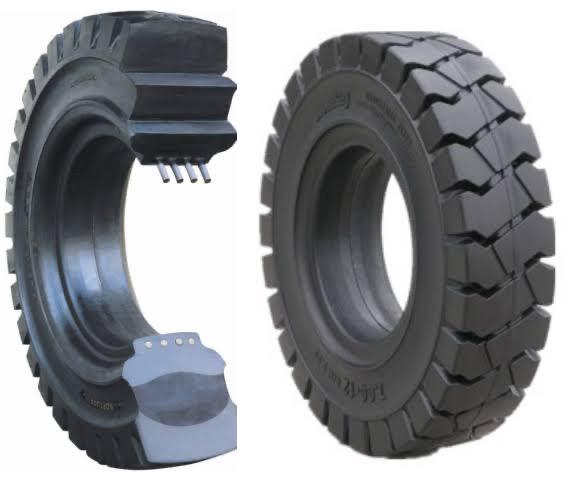
From the outside, a solid pneumatic looks identical to an air-filled tyre. Same profile, same tread pattern. But there’s no air cavity — it’s solid rubber compound all the way through.
The reason operators choose these is puncture elimination. If your Mitsubishi works in an environment where nails, metal swarf, or stone aggregate are part of the scenery — a steel fabrication yard, a building materials depot, a container terminal — a blowout or slow leak is a real operational risk. Solid pneumatics remove that risk entirely. The ride is firmer than an air tyre, but for most outdoor industrial applications, that’s an acceptable trade.
Pneumatic (Air-Filled) Tyres
Found mostly on Mitsubishi LPG and diesel counterbalance models used outdoors. Air tyres absorb the most shock, which is the reason they’re specified for rough terrain and uneven yard surfaces — they’re protecting the machine’s structural components as much as the operator.
The maintenance overhead is real. Pressure checks, puncture risk, slow leaks that go unnoticed until the handling gets odd. For operations that are genuinely split between rough outdoor use and warehouse floor work, it’s worth having a proper conversation about whether the comfort advantage of air tyres outweighs the maintenance load, or whether solid pneumatics are a better fit.
How Tyre Wear Actually Shows Up on a Mitsubishi
Mitsubishi counterbalance forklifts put the bulk of tyre stress at the front axle. The drive tyres carry the weight of the load, the mast, and the counterweight reaction — simultaneously. So the front tyres on a Mitsubishi wear considerably faster than the rear steer tyres, and the wear indicators matter more than most operators realise.
The 50mm Line
Most solid and cushion tyres have a moulded wear line built into the rubber. On Mitsubishi cushion tyres, this typically becomes visible when around 50mm of tyre height has worn away. At that point, you’re approaching the steel band. Once the band contacts the floor, you’ve got a floor damage problem, a handling problem, and a safety problem — all at the same time.
Don’t wait until you can see the wear line clearly. By then you’re already in the zone where tyre failure is likely rather than eventual. A quick monthly inspection — height, surface condition, any visible cracking or delamination — takes minutes and gives you enough warning to plan the replacement before the tyre forces your hand.
When the Wear Pattern Tells You Something Else is Wrong
Uneven wear across the tyre width is the tyre trying to tell you something isn’t right with the machine. Inner shoulder wearing faster than the outer? That’s usually axle alignment or a floor camber issue. You can replace the tyre, but if you haven’t sorted the root cause, the new one will wear the same way.
Flat spotting — those worn patches that create a thumping rotation — is almost always the result of aggressive braking habits. It’s common in operations with high throughput where operators are stopping and going constantly. Sometimes a brief conversation with drivers about braking technique does more for tyre life than any product upgrade.
Getting the Size Right — It’s Not Just About the Numbers
Tyre size on a Mitsubishi is an engineering spec, not a guideline. Fitting an incorrect size doesn’t just risk poor performance — it alters the forklift’s rated lift capacity and changes the geometry of the stability triangle. In some cases it invalidates the manufacturer’s warranty on load-related components.
Dimensions are expressed in either imperial (e.g., 6.50-10) or metric (e.g., 250/75-15) format. The spec is on the machine’s data plate — usually on the overhead guard or mast upright. If that plate is missing or no longer legible, the serial number is enough. Bring it to GP Forklifts and we can confirm the correct specification from there.
There’s also a load index component that often gets overlooked when fleet managers source tyres independently. Matching the dimensions without checking the load rating is a shortcut that creates a safety exposure. A tyre rated below the machine’s operating weight will behave correctly right up until it doesn’t.
Why How the Tyre is Fitted Matters as Much as Which Tyre You Buy
This one catches people out. You’ve sourced a quality tyre, the dimensions are correct, the compound is right for the environment — and then it gets pressed on incorrectly and fails six months later. By that point, nobody’s thinking about the fitment. Everyone assumes it’s a tyre quality issue.
Solid and cushion tyres need a hydraulic press to fit properly. Under-pressing leaves the tyre with micro-movement on the rim — it generates heat through that movement, and the bond fails. Over-pressing distorts the tyre profile and introduces stress concentrations that crack from the inside out. The press tooling also needs to match the specific rim profile. A general-purpose vehicle workshop press doesn’t cut it for industrial forklift tyres.
At GP Forklifts, the fitment is done on dedicated equipment sized for Mitsubishi rim profiles. It’s a detail that makes a measurable difference to how long the tyres actually last.
What Kills Forklift Tyres Faster in South African Conditions
Standard European or North American tyre life estimates don’t always translate to South African operating environments. A few specific factors that shorten tyre life significantly here:
- Floor heat. Dark concrete in poorly ventilated facilities can reach surface temperatures that soften solid rubber compounds. Tyres that would last 18 months in a temperate climate warehouse may give 12 in a Gauteng or KZN facility in summer without adequate ventilation.
- Pivot turns. When a forklift rotates around a stationary drive tyre, the rubber tears rather than wears. In tight aisle configurations where pivot turns are unavoidable, tyre life drops sharply. It’s worth knowing that going into the replacement cycle.
- Floor contamination. Oil, fuel, or chemical spills degrade rubber through direct chemical attack. Standard compound tyres in a facility that processes solvents or hydrocarbons will underperform significantly. The correct compound for those environments costs more upfront and lasts considerably longer.
- Overloading. Consistently operating above rated capacity doesn’t just stress the hydraulics — it compresses solid tyres beyond their load index, which causes permanent deformation and accelerated wear.
Rotation: When It Helps and When It Doesn’t
Front drive tyres on a counterbalance Mitsubishi wear at roughly twice the rate of the rear steer tyres. That gap naturally raises the question of tyre rotation as a cost-saving measure.
For pneumatic tyres that are wearing evenly and have no sidewall damage, rotation is a legitimate way to extend service life. For solid and cushion tyres, it’s more complicated. They’re directional and rim-mounted under compression. A solid tyre that’s reached its wear indicator cannot be moved to the rear position to extend its useful life — it’s worn, and moving it doesn’t change that. What it does do is introduce a height mismatch between the front and rear tyres, which affects the machine’s levelling.
The more practical approach is to replace front drive tyres in matched pairs. Putting a new tyre on one side and leaving a worn tyre on the other creates an imbalance that puts uneven stress on the mast and differential. The saving on one tyre is rarely worth what follows.
Why Operators Come Back to GP Forklifts for This Work
The short answer is that getting Mitsubishi tyre work right requires Mitsubishi-specific knowledge. General tyre suppliers can often source the correct dimensions. But matching the compound to the operating environment, confirming the load index against the machine’s capacity, pressing the tyre correctly, and giving you an honest forecast of how long it should last — that requires experience with industrial forklifts specifically.
Customers also come back to GP Forklifts because the approach to tyre scheduling is practical rather than reactive. Working replacement into the planned maintenance cycle means predictable downtime. A forklift that fails during a peak period costs far more in operational disruption than the tyres would have cost to replace a month earlier.
For fleet managers running multiple machines across multiple sites, the ability to source matched tyre sets and schedule fitment across the fleet reduces the administrative load. One supplier, consistent specifications, scheduled replacement — it’s a simpler way to manage what is otherwise a fragmented process.
Five Things You Can Do Now to Get More Life From Your Tyres
- Start a monthly tyre inspection checklist. Record tyre height, wear pattern, and any visible damage. The data will tell you when the replacement curve is approaching long before the tyre forces the issue.
- Brief your operators on pivot turns. Show them what a pivot turn does to the rubber compound. Operators who understand why the behaviour matters are far more likely to adjust it than operators who’ve only been told to.
- Maintain your concrete. Cracked, uneven, or contaminated floors accelerate tyre wear from the contact surface upward. Part of your floor maintenance budget is effectively a tyre maintenance budget.
- Check pneumatic tyre pressure weekly, not monthly. Under-inflation is the most common cause of early sidewall failure on air-filled forklift tyres, and it’s the easiest to prevent.
- Buy the right compound for your environment. Before ordering, have a conversation with the team at GP Forklifts about compound options. A standard warehouse tyre in a cold storage facility or a scrap metal yard will underperform and cost more over time than the correct compound would have upfront.
Frequently Asked Questions
How often should I replace tyres on a Mitsubishi forklift?
There’s no fixed calendar interval. Service life depends on hours in use, load weight, floor conditions, and operating habits. In high-intensity indoor operations, front drive tyre replacement every 12 to 18 months is typical. In lighter applications, well-maintained tyres can last three years or more. The correct measure is the wear indicator — not how long the tyres have been on the machine.
Can I fit a different brand from what Mitsubishi originally specced?
Yes, as long as the replacement matches the original size, load index, and compound type. Mitsubishi doesn’t require OEM-branded tyres to maintain the machine’s warranty — what matters is that the replacement meets the engineering specification. GP Forklifts stocks replacement tyres from reputable manufacturers that meet or exceed the Mitsubishi spec for the relevant model ranges.
What actually happens if I keep running on worn tyres?
On solid or cushion tyres past the wear indicator, the machine is no longer absorbing load shock through the tyre rubber — it’s transmitting it directly through the frame. That accelerates wear on mast channels, carriage rollers, and hydraulic cylinder seals. Those components cost considerably more to repair than a tyre replacement would have. In severe cases — where the steel band is already contacting the floor — you’re also looking at floor damage and unpredictable load handling.
Can I swap from pneumatic to solid tyres on an outdoor Mitsubishi model?
Not without proper engineering sign-off. Changing from air-filled to solid cushion tyres alters ride height, which affects the stability calculation and can change the forklift’s rated capacity. Solid pneumatic tyres — which maintain the same external profile as air tyres — are often a safer alternative for operations trying to eliminate puncture risk. GP Forklifts can advise on whether that option is appropriate for your specific model.
Does GP Forklifts offer on-site tyre fitting?
Yes. For fleet operations where transporting multiple machines to a workshop isn’t practical, GP Forklifts offers mobile fitting. Contact the team directly through the website with your fleet size, machine models, and site location.
Before You Place the Order
If you’re not certain which tyre type, compound, or specification applies to your machine, the simplest step is to contact GP Forklifts with the model number and serial number. That’s enough to confirm the correct specification and provide a quote. Getting it right at the point of purchase costs nothing extra. Getting it wrong tends to cost quite a bit more.