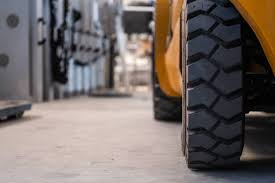
Tyres don’t announce when they’re becoming a problem. There’s no warning light, no alarm — the machine just keeps running while the costs quietly stack up elsewhere. Unexpected stops. Drivetrain repairs that seem premature. Operators reporting a rougher ride than usual. By the time the tyre itself looks obviously worn, the damage to your schedule and maintenance budget has already been done.
This is something we see regularly at GP Forklifts, particularly on Nissan forklifts that have been running hard across Gauteng’s industrial sites. The machines are tough — Nissan’s FG and FD series in particular hold up well under sustained use — but they depend on tyres that are correctly specified for the work they’re doing. Get that wrong and everything downstream suffers.
Here’s what you need to understand about Nissan forklift tyres to stop paying for a problem you don’t have to have.
Solid Tyres vs Pneumatic: It’s Not Just About the Surface
Most forklift operators know the basic split: solid tyres for indoors, pneumatic for outdoors. That’s broadly right, but it leaves out some important detail.
Solid tyres — also called superelastic or resilient tyres — are pressed onto the rim and can’t puncture. For a Nissan counterbalance forklift doing multiple shifts on polished concrete or an epoxy-coated warehouse floor, they’re the obvious choice. Lower maintenance, longer service life, and no inflation to monitor. The downside is that they transmit more vibration to the operator, which matters more than some managers realise — prolonged vibration over a long shift affects both comfort and concentration.
Pneumatic tyres, either air-filled or foam-filled, are what you need the moment your Nissan forklift crosses out of a smooth bay onto a gravel receiving yard, compacted earth, or any surface with meaningful irregularities. They absorb the kind of surface variation that solid tyres transfer straight into the machine’s frame and the operator’s seat.
Foam-filling is worth considering if punctures are eating into your uptime. The tyre behaves similarly to an air-filled pneumatic in terms of ride quality, but you eliminate the puncture risk entirely. For operations where the forklift moves between a clean interior floor and a rougher external area several times per shift, foam-filled tyres often represent the most practical compromise.
The Compound Question — and Why Most People Ignore It
Buy the right size in the wrong compound and you’ve still made an expensive mistake. Rubber compound determines how a tyre holds up against the specific stresses of your operating environment, and standard black rubber doesn’t cover every situation.
If your facility handles food, pharmaceuticals, or electronics, non-marking compounds prevent the black streaks that contaminate product areas or fail hygiene inspections. If your Nissan forklift operates near furnaces or hot-rolling equipment, standard rubber deteriorates far faster under thermal load than a heat-resistant compound would. In petrochemical or lubricant storage environments, oil contamination on the floor degrades standard tyre rubber from the outside in — and it happens faster than most people expect.
At GP Forklifts, we ask about your operating environment before recommending a compound, not after. The size question is straightforward; the compound question is where the real money is saved or lost.
What Your Wear Pattern Is Telling You
Tyre wear isn’t random. The pattern it leaves behind is diagnostic — it points to something specific about how the machine is being used or maintained. Learning to read it saves you from repeating the same mistake on a new set of tyres.
Centre wear — where the middle of the tread degrades faster than the edges — usually means the tyre is being asked to carry more than its rated capacity. On Nissan forklifts where load weights have crept up over time without a corresponding review of tyre specification, this is common.
Even edge wear on both sides often points to high-speed tight turning on abrasive concrete. The heat generated during that kind of operation concentrates at the shoulders and accelerates wear there specifically. It’s an operator behaviour issue as much as a tyre issue.
One-sided wear is almost never a tyre problem — it’s a wheel alignment or axle problem. Fitting new tyres without sorting the alignment means you’re starting the clock on the same wear pattern immediately.
Chunking, where sections of rubber tear away from the tyre body, indicates either chemical contamination, running over sharp debris repeatedly, or a compound that simply isn’t suited to the surface. If you see this on your drive tyres, the right response is to investigate the cause before fitting replacements.
Getting the Size Right
The tyre size for your Nissan forklift is on the existing tyre’s sidewall and on the data plate — usually mounted on the overhead guard or mast structure. Common sizes across the Nissan FG and FD counterbalance range include 21×8-9, 6.00-9, and 7.00-12, but this varies by capacity rating and model year, so don’t assume.
An oversized tyre can foul on the chassis or mast during turns. An undersized tyre reduces ground clearance and shifts the machine’s stability geometry in ways that matter when you’re carrying a load at height. Neither scenario announces itself until something goes wrong.
Our fitment team at GP Forklifts verifies the size against your actual machine — model number, year, and capacity rating — before pressing or mounting anything. It sounds obvious, but dimensionally correct on paper and correct for your specific variant aren’t always the same thing.
When to Replace — and the Cost of Waiting
There’s no fixed replacement interval that applies to every operation. A Nissan forklift running a single eight-hour shift on smooth concrete in a temperature-controlled environment will get considerably more life from a set of solid tyres than the same machine running double shifts across rough outdoor surfaces. What matters is knowing the indicators.
Most solid tyres carry a wear line moulded into the tyre body — when the surface reaches that line, the tyre is done. Beyond that:
- Visible chunking, cracking, or separation from the rim.
- Noticeably increased vibration during straight-line travel, which often means flat-spotting from being left stationary under load.
- Any change in load stability during lifting that can’t be explained by load-handling technique or mast condition.
The real cost of running worn tyres extends well past the tyre itself. Every shock load a worn tyre transmits into your forklift’s axle bearings, drive motor mounts, and mast cylinder seals shortens their service life. Replace a bearing six months early because of tyre-induced shock loading, and the repair bill easily outweighs several tyre replacements. On Nissan electric forklifts, flat-spotted or poorly rounded solid tyres increase rolling resistance and draw more amperage per metre, which shortens charge cycles and cuts productive hours per shift.
Then there’s the OHS angle. A worn drive tyre on a counterbalance forklift increases stopping distances and reduces lateral stability under load. If a tip or collision occurs and worn tyres are identified as a contributing factor, your liability position becomes significantly harder to defend.
Planned replacements on a maintenance schedule are almost always cheaper in total than emergency replacements — once you factor in unplanned downtime, expedited fitment, and the secondary mechanical damage that accumulates in the interim.
Why Gauteng Operations Use GP Forklifts for Nissan Tyre Work
South African operating conditions have their own character. You’re dealing with temperature swings that exceed what most European tyre specifications were written around, a mix of modern sealed floors and older industrial concrete that would qualify as rough terrain in another context, and supply chain pressures that make unexpected stoppages disproportionately costly.
GP Forklifts stocks tyre compounds and sizes matched to the Nissan models most commonly in service across Gauteng — from the 1.5-tonne units in FMCG distribution to the 3-tonne FD machines running in steel and construction supply yards. Our fitment process includes rim inspection and cleaning before pressing, torque-verified wheel nut tightening after mounting, and a brief operational check before the machine goes back to work. These aren’t optional steps we skip when we’re busy — they’re standard because rim corrosion causes premature tyre separation and undertorqued wheel nuts shift under load in ways that aren’t immediately obvious until they become serious.
For clients running larger Nissan fleets, we offer site visits where a technician assesses current tyre condition across all units, estimates remaining service life, and helps build a scheduled replacement plan. If you’re working within a fixed annual maintenance budget, having that forward visibility is worth considerably more than the cost of the visit.
Small Operational Changes That Extend Tyre Life Significantly
Operator behaviour is the factor that most tyre conversations skip over, probably because it’s harder to address than simply ordering a new set. Sharp high-speed turns — particularly loaded turns on abrasive concrete — do more cumulative damage to Nissan forklift drive tyres than straightforward load-carrying. Slowing before turning and avoiding spinning the drive tyres under heavy load can add hundreds of operating hours to a solid tyre’s service life. That’s a meaningful number when you’re budgeting replacements.
Floor condition matters almost as much. Steel swarf from nearby fabrication, broken pallet timber, and pooled chemical spills all accelerate tyre deterioration in ways that even a good compound can’t fully resist. A regular floor inspection and cleaning routine in the operating area is one of the cheaper interventions available to you.
For pneumatic tyres on outdoor Nissan forklifts, checking inflation at the start of each shift takes under two minutes and prevents the uneven wear and increased puncture vulnerability that comes with running at incorrect pressure. The recommended pressures are in the operator manual and on the machine’s data plate — they’re there because they matter.
Frequently Asked Questions
What tyre type is standard on a Nissan FG counterbalance forklift?
Most Nissan FG series forklifts leave the factory configured for solid cushion tyres on the drive axle, with solid or semi-pneumatic tyres on the steer end. The correct specification depends on your model number and year — GP Forklifts can confirm this from your machine’s data plate.
How long do solid tyres typically last on a Nissan forklift in warehouse conditions?
On smooth concrete under normal single-shift operation, somewhere between 3,000 and 5,000 operating hours is a reasonable expectation. Operations involving rough surfaces, heavy loads close to the rated capacity, or frequent tight-turning will see that figure drop. Inspecting every 500 hours gives you enough lead time to plan replacements without waiting for visible failure.
Can I fit any solid tyre to my Nissan forklift if the diameter matches?
No. The tyre needs to match the rim width, load index, and operating compound — not just the diameter. Fitting a tyre with an insufficient load rating to a Nissan forklift running at capacity is both a mechanical risk and a compliance issue under South African OHS regulations.
What’s the practical difference between foam-filled and solid tyres for a Nissan forklift?
Solid tyres are moulded rubber throughout — no air, no fill, purely suited to smooth indoor surfaces. Foam-filled tyres start as standard pneumatic tyres and are injected with polyurethane foam, making them puncture-resistant while keeping the cushioning you’d expect from a standard pneumatic. They suit mixed operations where you need some surface shock absorption but can’t afford puncture-related downtime.
Does GP Forklifts offer on-site tyre fitting for Nissan forklifts in Gauteng?
Yes — for larger fleets or machines that can’t be easily transported, GP Forklifts provides on-site fitment and fleet tyre assessments across Gauteng. Get in touch directly to discuss your fleet size and arrange a visit.
For Nissan forklift tyre supply, fitment, and fleet assessments across Gauteng, contact GP Forklifts.