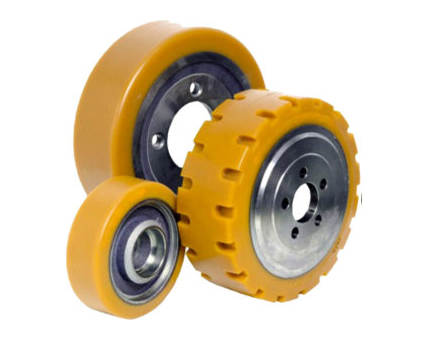
The right forklift tyre is decided by four things: where the machine operates, what it carries, how long it runs each day, and what your operation can afford over a full replacement cycle. Get any of those four wrong and you’ll either wear through tyres too fast, pay too much for a specification you don’t need, or deal with downtime at the worst possible time.
This guide walks through each factor in turn, with enough context about South African operating conditions to help you arrive at the correct spec for your fleet.
Step 1: Know your surface before anything else
Surface type is the single biggest factor in forklift tyre selection. It determines not just which tyre type to choose, but also which rubber compound and tread pattern will give you the best service life in your specific environment.
Sealed concrete floors, the standard surface in most South African warehouses, distribution centres, and factory floors, are the ideal environment for solid tyres. The surface is smooth enough that the tyre doesn’t need to absorb significant ground impact, and the controlled environment means you’re unlikely to encounter debris that would damage a solid tyre more than normal wear.
Outdoor yards, loading docks, and construction sites are a different story. Compacted gravel, broken concrete, and unpaved surfaces put sustained stress on a tyre’s sidewall and carcass. Here, pneumatic tyres earn their keep because the air cushion absorbs the impact that would otherwise be transferred straight to the chassis and the load.
Mixed environments, where the forklift regularly crosses between indoor floors and outdoor surfaces, are where the specification question becomes genuinely difficult. The options are to run pneumatic tyres and accept faster indoor wear, to use solid pneumatic tyres (solid rubber in the pneumatic tyre shape) as a compromise, or to run separate tyre specifications across different units in the fleet that work different areas.
Step 2: Match tyre type to your specific application
Once you know the surface, you can choose the tyre type. The main options in the South African market are:
Tyre type | Best for | Not suited to | Typical cost range |
Solid (press-on) | Indoor warehouse, factory, smooth concrete | Rough outdoor surfaces, uneven terrain | R1,500–R4,500 per tyre |
Pneumatic (air-filled) | Outdoor yards, construction, uneven ground | Debris-heavy environments (puncture risk) | R800–R2,500 per tyre |
Solid pneumatic | Mixed indoor/outdoor, moderate terrain | Heavy outdoor rough terrain | R1,800–R4,000 per tyre |
Cushion (press-on) | Small electric forklifts, smooth indoor only | Any outdoor or uneven surface | R500–R1,200 per tyre |
Polyurethane | Food/pharma/clean room applications | Outdoor, rough surfaces, heavy loads | R2,000–R5,000 per tyre |
The polyurethane option is worth noting for South African food processing, pharmaceutical, and cold-chain operations. Polyurethane tyres are non-marking, chemical-resistant, and provide consistent performance in cold-storage environments where standard rubber compounds can harden and crack.
Step 3: Factor in shift hours and load weight
A tyre that performs well under 8 hours of use per day may fail prematurely under 16-hour double shifts. Most solid tyre manufacturers differentiate their product ranges by shift length for this reason.
For operations running 8 hours or fewer per day, a standard single or two-layer solid tyre compound is appropriate. For 8 to 16-hour operations, a premium three-layer compound tyre with higher heat resistance is the better long-term investment. The rubber compound in a three-layer tyre dissipates heat more effectively, which directly affects how long the tyre lasts before the rubber begins to harden and develop flat spots.
Load weight is equally important. If your forklift regularly carries loads close to its rated maximum, the tyre is under sustained compression stress with every lift and every turn. This accelerates wear and increases heat build-up in solid tyres. Under-speccing on tyre grade for a high-load operation is a common mistake that leads to replacing tyres more often than necessary.
Step 4: Understand total cost of ownership, not just the unit price
The upfront price per tyre is rarely the most useful number when comparing options. What matters is the total cost over the tyre’s service life, factoring in how long the tyre lasts, whether it causes any associated damage (to floors, to the forklift’s mast and bearings from vibration, to loads from instability), and what the maintenance overhead is.
Solid tyres are the clearest example. They cost significantly more per tyre than pneumatics, but they last two to three times longer on smooth warehouse surfaces and produce zero puncture-related downtime. A R3,000 solid tyre that lasts 3 years will typically beat a R1,200 pneumatic that requires replacement every 18 months and generates one callout per year for puncture repairs.
The TCO calculation also needs to include floor damage costs, which are easy to overlook. Under-inflated pneumatic tyres leave tyre marks and drag damage on sealed warehouse floors. Worn solid tyres develop flat spots that create impact damage on the floor surface during turns.
Step 5: Match the tyre to your forklift brand and model
Not every tyre size fits every forklift. Rim design, axle configuration, and the manufacturer’s rated tyre specifications all limit what you can fit to a given machine. Fitting an incorrect tyre size affects the forklift’s rated load capacity, its clearance height, and its stability under load.
The most reliable way to confirm the right tyre for your forklift is to check the existing tyre’s sidewall markings, or provide your forklift’s make, model, and serial number to a tyre supplier who can confirm the specification from their records. GP Forklifts maintains tyre specifications for all major forklift brands operating in South Africa. Call 010 110 1819 with your make and model and we’ll confirm the correct size and type.
Step 6: Account for South African-specific operating conditions
South Africa’s climate and terrain diversity create tyre selection considerations that a generic buying guide written for European or North American conditions may not cover.
Gauteng’s highveld plateau sits at around 1,700 metres above sea level with an average summer temperature that routinely exceeds 30 degrees Celsius. Steel-roofed warehouse buildings in Johannesburg, Germiston, and Kempton Park can reach floor temperatures of 45 degrees or more during summer months. This matters for solid tyres because rubber compounds that aren’t heat-rated for these conditions will harden faster, develop flat spots earlier, and lose grip on smooth floors.
The KwaZulu-Natal coast, including Durban’s major port and logistics facilities, adds humidity and salt air to the picture. Pneumatic tyres in coastal environments need more regular pressure checks and rim inspection because moisture can enter past rim seals and corrode the inner tube and liner flap from the inside.
Cape Town and the Western Cape present a different set of conditions: cooler average temperatures but higher rainfall and outdoor humidity during the winter months. For outdoor operations in the Cape, tread pattern on pneumatic tyres matters because wet surfaces significantly reduce grip on a worn tread.
Frequently asked questions
Can I use the same forklift tyre for both indoor and outdoor operations?
A solid pneumatic tyre is the closest option to a tyre that performs acceptably in both environments. It has the wider profile and traction advantage of a pneumatic but eliminates puncture risk by being solid rubber throughout. That said, it is a compromise: it won’t perform as well as a dedicated solid tyre on smooth indoor floors, and it won’t match a genuine pneumatic on rough outdoor ground. If your operation has distinct indoor and outdoor fleets, specifying correctly for each is the better long-term choice.
How do I know if my forklift needs solid or pneumatic tyres?
Look at where the forklift spends most of its operating hours. If the majority of work is on sealed concrete indoors, solid tyres are the correct specification. If the forklift regularly operates on outdoor surfaces, loading docks, or construction sites, pneumatic tyres are the right choice. If you’re unsure, contact GP Forklifts with your forklift’s make and model on 010 110 1819 and we’ll advise on the specification.
Does load capacity affect which forklift tyres I should buy?
Yes. Heavier loads put more compression stress on the tyre, particularly during lifts and turns. For operations consistently carrying loads near the forklift’s rated maximum, a premium compound tyre with better heat resistance and structural integrity is the more cost-effective choice over time. Budget tyres on high-load applications wear down significantly faster.
What is the difference between a 2-layer and 3-layer solid forklift tyre?
The layer count refers to the construction of the rubber compound. A 2-layer solid tyre has a harder outer tread compound and a softer inner core, suitable for standard 8-hour warehouse shifts. A 3-layer tyre adds a third compound zone that improves heat dissipation, making it better suited to 16-hour double shifts or operations in hot environments. For most single-shift warehouses, a 2-layer tyre is appropriate. For intensive operations, the 3-layer tyre pays for itself in extended service life.
How many forklift tyres does a counterbalance forklift have?
Most counterbalance forklifts have four tyres: two large drive tyres on the front axle and two smaller steer tyres on the rear axle. Some three-wheel electric forklifts have only three tyres. When budgeting for a full tyre replacement, factor in all four positions and confirm whether the front and rear positions take the same tyre size, as they often don’t.