

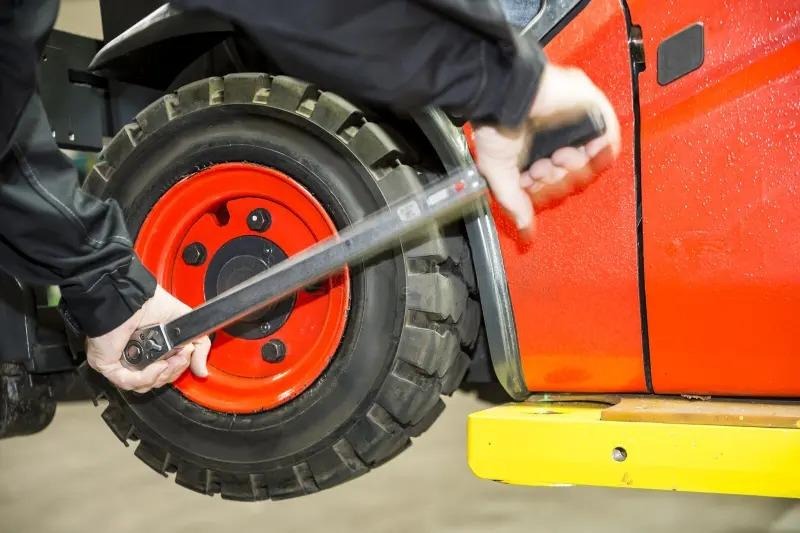
Most forklift tyre failures don’t happen suddenly. They announce themselves well in advance through specific, observable changes in the tyre’s appearance and the forklift’s behaviour. The problem is that the signs can be easy to dismiss, especially when operations are under pressure and replacing tyres means taking a machine out of service.
Leaving worn tyres in service too long costs more than replacing them early. A tyre that’s past its useful life affects load stability, increases operator fatigue, and in the worst case can cause a load to drop or a machine to tip. This guide covers the seven signs to watch for across all three main tyre types used in South African operations.
The signs differ by tyre type
Before going through the signs, it’s worth stating something that catches many fleet managers out: the replacement indicators for solid tyres are different from those for pneumatic tyres. Using the pneumatic tyre logic on a solid tyre will lead you to replace it either too late or unnecessarily early, depending on how you read it.
Sign 1: The wear line is reached (all tyre types)
Most solid and pneumatic forklift tyres have a wear line or safety line marked on the sidewall. For solid tyres, this is usually indicated by a groove or a colour-change indicator built into the compound layers. When rubber wear reaches this line, the tyre is at its structural limit and must be replaced.
For solid press-on tyres, the general guideline from most manufacturers is to replace when the rubber height has reduced to approximately one-third of the original height. Some will tell you two-thirds of the original rubber is gone. If you don’t have the manufacturer’s spec sheet to hand, a practical rule is: if the tyre looks noticeably shorter than when it was new, get it assessed.
On pneumatic tyres, the tread wear indicator is a small raised bar across the tread grooves at 1.6mm depth. When the tread surface wears level with these bars, the tyre has reached legal minimum tread depth. In practice, you should replace well before this point, particularly for any operations that move outdoors or onto wet surfaces.
Sign 2: Flat spots across the contact surface (solid and cushion tyres)
Flat spots develop on solid and cushion tyres when the forklift brakes hard or turns sharply on a loaded mast, causing the tyre to scrub rather than roll. A flat spot is a section of the contact surface that has been worn flat instead of retaining its rounded profile.
A forklift with flat-spotted tyres vibrates noticeably at operating speed. Operators describe it as a rhythmic thumping through the seat and controls. Beyond driver discomfort, the vibration also transmits through the forklift’s mast and hydraulic system, accelerating wear on components that have nothing to do with the tyres.
Flat spots that are caught early may be reparable through professional tyre cutting, where a new profile is cut into the remaining rubber. Once the flat spot has worn down close to the wear line, replacement is the only safe option.
Sign 3: Chunking or tearing at the tread (all tyre types)
Chunking is when pieces of rubber break away from the tread surface in irregular chunks. It can happen suddenly under extreme loading or develop gradually on a tyre that’s been running on the wrong surface or carrying loads above its rating.
Any chunking on a solid tyre is a strong indicator that the rubber compound has hardened beyond its useful life, often from heat build-up in a high-intensity or under-specified application. Chunked tyres should be taken out of service immediately. The uneven surface creates unpredictable load distribution and the compromised structure can fail further under load.
On pneumatic tyres, chunking of the tread compound is less common than on solids, but tearing of the sidewall is more of a risk. Cuts or tears in the sidewall can cause sudden air loss, which on a loaded forklift is a serious safety event.
Sign 4: Cracking at the base or sidewall
Cracking along the base of a solid tyre, where the rubber meets the metal rim, or across the sidewall of any tyre type, indicates rubber degradation from age, heat cycling, or chemical exposure. In South Africa, ozone and UV exposure accelerate this process on tyres stored or operated outdoors, even on machines that don’t operate frequently.
Fine surface crazing is a normal sign of ageing rubber and doesn’t necessarily mean immediate replacement. Deep cracks that penetrate the rubber compound, particularly at the base of a solid tyre or on the inner sidewall of a pneumatic, indicate structural compromise and require replacement before the tyre is used under load.
Sign 5: Visible rubber separation from the rim (solid tyres)
On a solid press-on tyre, the rubber is bonded to and pressed onto a steel band or directly onto the rim. If the rubber is beginning to separate, lift, or pull away from the rim at any point around the circumference, the tyre must come off immediately. A solid tyre that separates from its rim under load will cause an instant loss of support on that corner of the forklift.
Rubber-to-rim separation is most common on tyres that have been in service well past their replacement point, or on tyres that were installed incorrectly or on a damaged rim. During your tyre inspection, run a visual check around the full circumference where the rubber meets the rim.
Sign 6: Increased driver fatigue and complaints
Forklift operators will often notice that something is wrong with the tyres before a visual inspection picks it up. If operators are reporting unusual vibration, difficulty steering, or a forklift that feels less stable than usual, tyres should be the first thing inspected.
This matters beyond comfort. Forklifts have no suspension, which means operators absorb approximately 80% of the shock when driving over uneven surfaces or on a worn tyre. Prolonged exposure to vibration causes back and joint fatigue, reduces attention and accuracy, and is a contributing factor in operator errors. Under the Occupational Health and Safety Act, you have a duty to provide equipment that is safe to operate. A forklift with worn tyres that causes physical discomfort is not meeting that standard.
Sign 7: The forklift feels unstable under load at height
This is the most serious sign on the list. If a forklift feels unstable, rocks, or lists to one side when carrying a load at height, the tyre condition should be checked immediately, alongside the hydraulic system and mast components.
Worn or underinflated tyres change the forklift’s stability triangle, which is the geometric relationship between the two front wheels and the rear steer axle that determines safe operating parameters. A tyre that has lost significant rubber height on one side, or a pneumatic tyre running low on pressure, effectively shortens one leg of that triangle and shifts the tipping threshold.
This is also why load testing matters. A valid load test doesn’t just certify the hydraulics; it tests the machine as a whole, including the effect of tyre condition on stability at rated lift height. A forklift that passes its load test on new tyres and then runs those same tyres into the ground is effectively operating at a reduced safe capacity without anyone formally noting the change.
When should each tyre type be replaced? Quick reference
Tyre type | Replace when… | Do not wait if… |
Solid press-on | Rubber height at manufacturer’s wear line, or flat spots visible | Chunking, base cracking, rim separation, or rubber hardened and discoloured |
Pneumatic | Tread at wear indicators or 2mm remaining | Sidewall cuts or bulges, cord visible, loss of pressure that cannot be inflated |
Cushion | Top worn to wear line (approx. 1/3 rubber remaining) | Flat spots, tearing, or irregular wear across the contact surface |
How to check your forklift tyres before each shift
- Walk around the forklift and visually inspect all four tyres before starting.
- On pneumatic tyres, check inflation pressure with a gauge. Do not rely on visual inspection for pneumatic pressure.
- Look at the contact surface on all tyres: check for flat spots, chunking, cracking, and foreign objects embedded in the tread.
- Check the sidewalls of pneumatic tyres for cuts, bulges, or cord showing through the rubber.
- On solid tyres, check the base of the tyre where rubber meets rim for any signs of separation.
- Report any concerns to the responsible person before operating the forklift. Do not assume a damaged tyre is safe to run on for one more shift.
Frequently asked questions
How long should forklift tyres last in South Africa?
This varies considerably by tyre type, operating hours, surface conditions, and load intensity. As a rough guide on smooth warehouse concrete in single-shift operation: solid tyres typically last 2 to 4 years. Pneumatic tyres in outdoor mixed-use operations typically last 1 to 3 years. Actual service life can be significantly shorter under high-intensity or high-heat conditions, or significantly longer for machines that operate fewer hours per day.
Can forklift tyres be retreaded or repaired?
Solid tyres cannot be retreaded, but a specialist can cut a new profile into a solid tyre that has worn flat if sufficient rubber remains above the wear line. This extends the tyre’s life without full replacement. Pneumatic tyres can be repaired for punctures in the tread area, but sidewall damage generally cannot be safely repaired and requires full replacement. Contact GP Forklifts on 010 110 1819 if you’re unsure whether a tyre can be serviced or needs to be replaced.
Does running a forklift on worn tyres affect the load test result?
Tyre condition is assessed as part of a load test inspection. If the tyres are found to be worn below the safety threshold, the inspector will flag them as a defect in the report. The forklift will then need new tyres and a retest before a valid load test certificate can be issued. Replacing worn tyres before the load test saves the cost of a failed inspection and a return visit.
What happens if a solid forklift tyre goes flat?
Solid tyres cannot go flat. This is one of their main advantages in warehouse applications where puncture downtime is a productivity concern. If your solid tyre is losing height visibly, that is normal rubber wear over time, not a flat. The tyre is replaced when the wear line is reached or when structural signs of failure appear, not when air pressure drops, because there is no air to lose.
Who should I contact in Johannesburg to inspect my forklift tyres?
GP Forklifts can assess tyre condition across your fleet and provide a quote for replacement as needed. We cover Johannesburg and Gauteng from our Edenvale facility. Call 010 110 1819 or email sales@gpforklifts.co.za to arrange a fleet tyre inspection or to order replacement tyres.
