GP Forklifts | Forklift Tyres, Johannesburg and nationwide
Ask five forklift operators how long a set of tyres should last, and you’ll get five different answers, none of which are wrong. A forklift running three shifts a day on a rough outdoor yard in Boksburg will chew through tyres at a completely different rate to one gliding across a polished warehouse floor in Midrand. What actually matters isn’t the calendar, it’s the wear itself, and knowing exactly what to look for.
Here’s the short version, before we get into the detail: solid tyres are generally good for somewhere between 2,000 and 3,000 operating hours, pneumatic tyres tend to wear out faster, especially outdoors on rough or abrasive surfaces, and polyurethane press-on tyres sit somewhere in between depending on load and floor condition. Those numbers move a lot depending on how the forklift is used, so treat them as a starting point, not a promise.
The safety line most operators never check
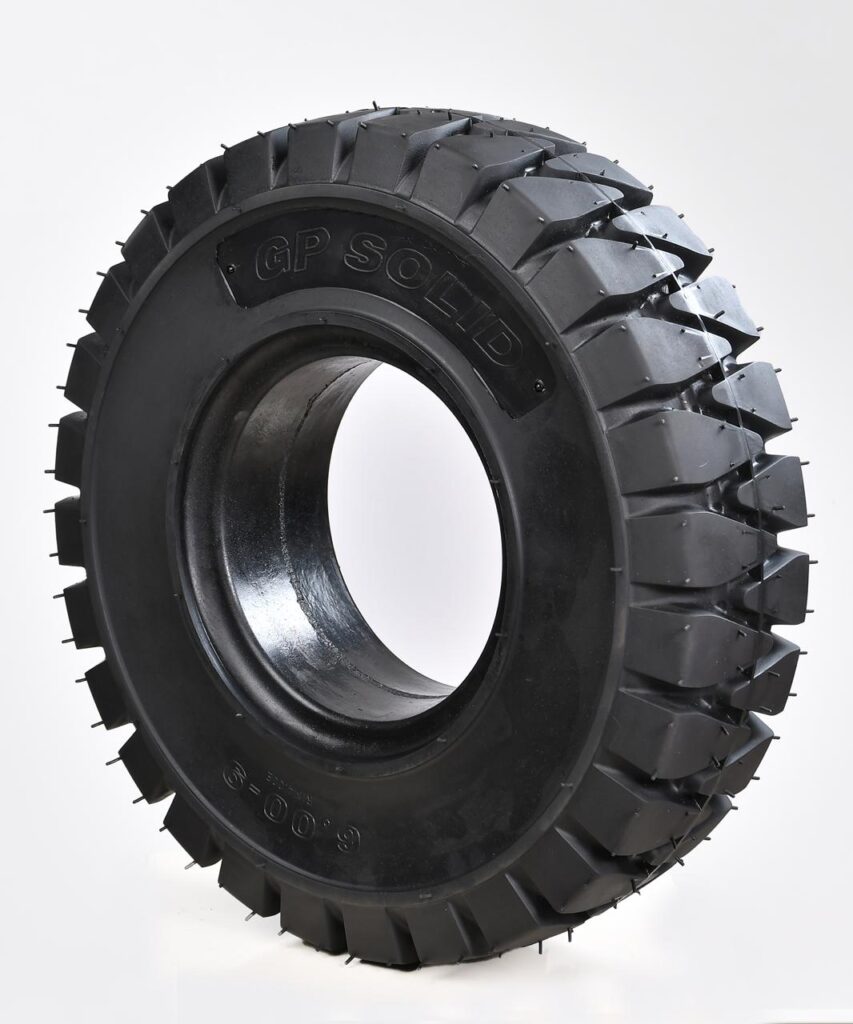
Solid forklift tyres are moulded with a wear indicator built into the rubber, usually referred to as the 60J line or safety line. It’s a groove on the sidewall that marks the point where the tyre’s tread has worn down into the softer core material underneath. Once you’ve worn past that line, the tyre can no longer be re-grooved and needs replacing, full stop. It’s easy to miss if nobody’s looking for it, which is exactly why so many forklifts run on tyres that should have been swapped out months earlier.
Pneumatic tyres don’t have a safety line in the same way, but the rule of thumb our technicians use is straightforward: once tread depth drops below roughly 3mm, or you can see cuts deep enough to expose the internal ply, the tyre needs to come off. Waiting for a puncture to make the decision for you is the expensive way to find out.
Five signs your tyres are past their best
- Flat spots, usually caused by hard braking or spinning under load, which throw the wheel out of balance and make the ride noticeably rougher.
- Chunking or tearing, where chunks of rubber have broken away rather than worn down evenly. This is a safety issue, not just a cosmetic one.
- Uneven wear across the width of the tyre, often a sign of misalignment or a forklift that’s been overloaded regularly.
- Visible cracking in the sidewall, particularly common on tyres that have sat in Highveld sun for a few summers without much rotation.
- A noticeable drop in ride height. Once a tyre has lost more than a couple of centimetres from its original diameter, ground clearance under the mast starts to disappear too.
What waiting too long actually costs you
This is the part that gets glossed over. A worn tyre doesn’t just ride rough, it changes how the whole forklift behaves. Reduced ground clearance means the underside of the mast and the counterweight sit closer to the floor, so speed bumps, uneven concrete joints and loading dock lips start making contact with the chassis. That’s how a R2,000 tyre delay turns into a mast repair or a damaged steer axle. Stopping distances also increase on worn tyres, which matters a great deal when you’re carrying a loaded pallet through a busy warehouse aisle.
We cover the broader warning signs across the whole machine, not just tyres, in our guide on signs your forklift needs immediate repair. Worth a read if you’re not sure whether what you’re seeing is a tyre problem or something bigger.
Getting the timing right for your fleet
The honest answer is that tyre life comes down to four things: the type of tyre, the surface you’re running on, how heavy the loads are, and how the operators drive. A forklift that’s dragged sideways into position twenty times a shift will burn through rubber far quicker than one that’s driven and positioned properly. If you’re not sure where your fleet sits, we’re happy to have a look and give you a straight answer rather than an upsell.
We stock and fit solid, pneumatic and polyurethane tyres for all the major brands running in South Africa, and you can see the full range on our forklift tyres page. If you already know your tyre size, our forklift tyre size chart will help you confirm it before you order.
Quick answers
How often should forklift tyres be replaced?
There’s no fixed schedule. Replace them when they reach the wear indicator (the safety line on solid tyres, or roughly 3mm tread depth on pneumatics), or sooner if you spot chunking, cracking or flat spots.
Can a worn solid tyre be re-grooved instead of replaced?
Yes, up until it reaches the safety line. Once you’re past that line, the tyre has to be replaced rather than reworked.
Do all four tyres need replacing at the same time?
Not always, but mismatched tyre heights on the same axle cause uneven handling and accelerated wear on the newer tyre. Our technicians will tell you honestly when a single replacement is fine and when you’re better off doing the pair.
Not sure what state your tyres are in?
Book a quick inspection with GP Forklifts and we’ll tell you plainly whether you’ve got months left or whether it’s time to book a fitment. Call GP Forklifts on 010 110 1819, or email sales@gpforklifts.co.za, and we’ll sort out the rest.