GP Forklifts | Forklift Tyres, Johannesburg and nationwide
We get this question almost every week, usually from someone who’s just been quoted three different tyre types for what they thought was a simple replacement. The truth is there’s no single “best” forklift tyre. There’s only the right tyre for what your forklift actually does, day to day, on the surfaces you actually run on.
Solid tyres: built for punishment, not comfort
Solid tyres are exactly what they sound like: a single piece of moulded rubber with no air chamber, which means no punctures, no slow leaks, and no compressor call-outs at 6am. They’re the default choice for yards with sharp debris, offcuts, nails or scrap metal on the floor, and for operations where a flat tyre mid-shift simply isn’t an option.
The trade-off is ride comfort. Solid tyres transmit more vibration to the mast, the load and the operator, which matters over an eight or twelve hour shift. They’re also heavier, which slightly increases power consumption, particularly noticeable on electric forklifts.
Pneumatic tyres: grip and cushioning for rough or outdoor ground
Pneumatic tyres are air-filled, with a deeper tread pattern that grips loose or uneven surfaces, gravel yards, and outdoor loading areas far better than a solid tyre can. They absorb shock more effectively too, which is worth considering if your forklifts spend serious time outdoors on tar, gravel, or unfinished surfaces around a construction or logistics site.
The obvious downside is that they can be punctured, and a flat pneumatic tyre on a loaded forklift is a genuine safety hazard, not just an inconvenience. Solid pneumatic-shaped tyres exist as a middle ground here, giving you the tread pattern and profile of a pneumatic without the air chamber, at a bit of a comfort cost.
Polyurethane and cushion tyres: smooth floors, electric forklifts, tight spaces
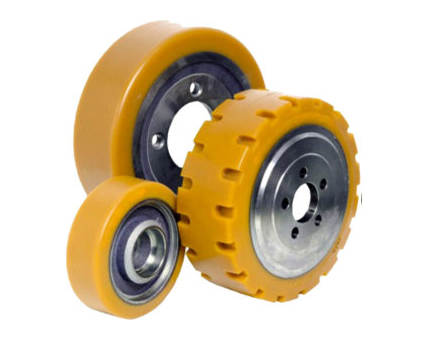
Polyurethane press-on tyres are the standard fit for electric forklifts working indoors on flat, sealed concrete. They’re lighter than solid rubber, roll with less resistance (which stretches battery life a bit further), and their low profile suits forklifts designed for narrow aisles and tight warehouse layouts.
Take a polyurethane-tyred forklift outside onto gravel or a cracked yard surface, though, and you’ll see the wear rate climb fast. These tyres simply aren’t built for it.
Matching the tyre to where the forklift actually works
- Smooth indoor warehouse floor, electric forklift, narrow aisles: polyurethane or cushion tyres.
- Mixed indoor and outdoor use, sealed yard, occasional debris: solid tyres, sometimes solid pneumatic-profile.
- Gravel yards, construction sites, unfinished outdoor surfaces: pneumatic tyres for the grip and cushioning.
- Cold storage or food-grade environments: non-marking compounds are worth asking about regardless of tyre type, since they leave no black scuffing on floors.
Why the brand of forklift sometimes decides the tyre for you
Tyre sizing and load ratings are set by the forklift manufacturer, not chosen freely. A Toyota electric model and a Linde diesel model of similar capacity can call for quite different tyre specifications, so it’s worth confirming the manufacturer’s original fitment before assuming last year’s replacement size is still correct, especially if the forklift has changed hands or been reconditioned. Our forklift tyre size chart covers the common sizing patterns by brand if you want to double-check before ordering.
If you’re weighing this up for Johannesburg conditions specifically, our piece on choosing forklift tyres for Johannesburg’s climate goes into the seasonal side of things, since a tyre that’s fine in a dry Highveld winter can behave very differently once the summer storms start.
Quick answers
Can I fit solid tyres to a forklift designed for pneumatic tyres?
Often yes, using a solid pneumatic-profile tyre matched to the same rim and load rating, but it needs checking against the forklift’s original specification first. Get this wrong and you affect stability and ground clearance.
Which tyre type lasts the longest?
Solid tyres usually last the longest in hours, simply because there’s no air pressure to maintain and nothing to puncture. Pneumatic and polyurethane tyres can outlast solid tyres in specific conditions where solid rubber wears unevenly, so surface and application matter more than the general rule.
Do non-marking tyres wear out faster?
Yes, typically. Non-marking rubber compounds are softer, which is what stops them leaving scuff marks, but that same softness means they wear down somewhat quicker than standard black rubber under identical conditions.
Still not sure which tyre suits your operation?
Tell us what surfaces your forklifts run on and how they’re loaded, and we’ll recommend the right tyre rather than the most expensive one. Call GP Forklifts on 010 110 1819, or email sales@gpforklifts.co.za, and we’ll sort out the rest.